

If you ask me, “Who’s your favorite person in metal?” my answer would be Charlotte Wessels, hands down. I’ve been (and still am) a huge fan of Delain, and I was lucky enough to catch her on their final tour together. What blew me away wasn’t just her incredible talent, but her ability to connect with and unite fans. Back in 2020, we had the chance to interview her after the release of Delain’s Apocalypse & Chill. Now, we’ve caught up again to talk about her solo album, The Obsession.
Can you share with us about the emotional journey behind crafting the songs of “The Obsession”?
I think in terms of the emotional contents of the record, less so than the songs are consciously crafted. Like, often I feel in a certain way and I process it through music and writing about it. And then afterward, I ask myself: “Am I going to let people hear this? Am I going to put it on an album? And am I actually going to say what it’s about?” So with this album, that journey was also kind of atypical.
But because it wasn’t until, I think February of this year, when I sat down and looked at all of the songs and realized, okay, this is an album about fear. Because I had not intentionally put that there. But yeah, it turned out that eventually, the album had that flow of having lots of songs about fear and obsessive thoughts and the escapes from them.
So I thought, okay, if that’s what it is, then I will call it “The Obsession”. And call it by its name.
You invited ex-Delain members to this album. How did that reunion influence the sound of “The Obsession” compared to your previous solo work?
Well, it did change the sound and the songs on many levels. First of all, of course, by their performances, the heart that they put into the songs, and also their personality and their creativity. And Timo, for example, didn’t only perform his parts, but he was also very-very involved in the rearranging of the songs, because I still made the first versions of the songs here, in the basement by myself with my digital instruments.
So, we kind of worked on all levels, on the writing level, on the arrangement level, and then obviously at the performance level, when they actually played the songs in the studio.
During our last interview, you shared with us how inspiration came from everyday life. Has your creative process changed since then?
I think it still comes from everyday life. It still comes from the world around me, what I’m going through. Depending on the situation, it will be more introspective around my personal feelings and emotions.
Or more outwards or societal challenges. Or sometimes, you know, when like with “Ode to the West Wind”, where I just get really inspired by a beautiful piece of poetry and work from that. Inspiration is to be found anywhere.
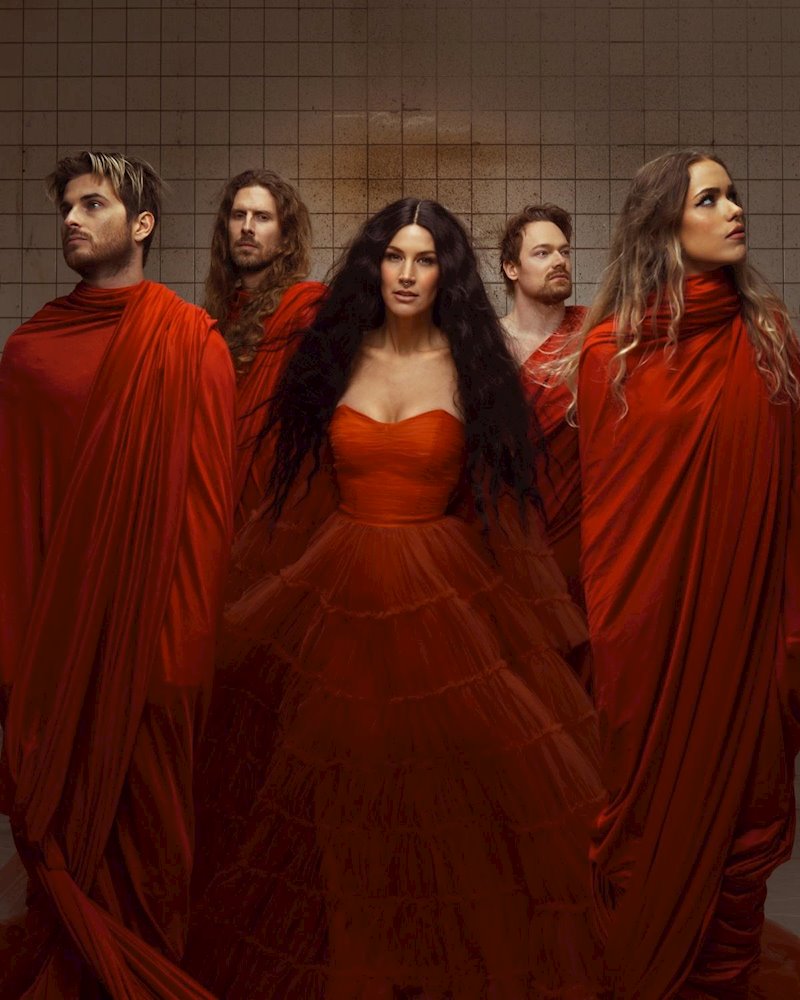
How would you describe the thematic core of The Obsession, and what’s the visual narrative behind its artwork?
I think the thematic core is very much a fear. So, we shot the photography that is at the heart of the artwork. We shot that during the video recordings for “The Exorcism” and “Chasing Sunsets”. Tim Tronckoe, who shot the photos, was also directing those videos.
He worked together with Claire Stuart from Blond en Blauw Films for that. Great team! And what we wanted to do on the cover, is to personify that fear.
On the cover, you can see me leaning into this fabric and next to my face, there’s a person who is kind of pushing through. This was meant to represent that fear. And you also see it throughout “The Obsession” – that fear kind of grabbing all around me and the band members. And there’s the other scene where I’m kind of tied to her, wrapped with our heads. This is Lidewij, by the way, she’s an amazing dancer, and she’s also Joey’s girlfriend.
One moment it looks like an embracement and the other moment it looks like we’re trying to get away from each other. So we tried to visualize this in all different sorts of ways.
But also kind of my own weird relationship, where I’m never really sure if it’s something else or whether I’m actually doing it to myself.
For example, with the themes where I’m kind of holding arrows to my own chest. So yeah, we tried to make it visible in all kinds of ways in the photographic and videographic department. Nina made a lot of the decors and sets. And then another Nina, very confusing (laughs), from Studio Detour, made collages then with the material that we shot.
I think these collages kind of amplify or mirror the feeling that we put into those photos. So it’s really come all together and I’m really happy with it. We really wanted to visualize the different faces of fear.

In 2020, you highlighted “Legions Of The Lost” and “Masters of Destiny” as your favorites from Apocalypse & Chill. Which tracks from The Obsession hold a similar special place in your heart, and why?
I think “The Exorcism” – this is probably the most personal. Also, I cannot sing it without having the initial feeling that I wrote it with.
And “Chasing Sunsets”, because it just has a lot of things that I like. It has a very catchy hook and a very-very melodic breakdowns. It has a nice theme. It has a heavy riff. So I like its musical diversity.
How difficult it was to build your online presence as a solo artist?
The pandemic wasn’t easy. But it wasn’t easy for anyone. What was the biggest challenge? I don’t know.
Self-doubt, impostor syndrome, you know, all those things. I think those are the biggest challenges. They’ve been holding me back a little bit.
Simone Simons and Alissa White-Gluz gave amazing performances on The Obsession. Were they “just” guest vocalists, or did they help co-write the duets? How did the creative process work when shaping songs like “Dopamine” and “Ode to the West Wind”?
I had already written the first version of both of the songs and put them on Patreon before I asked them. But I knew, of course, that they’re both super skilled, but also very creative vocalists. So, you know, even though the parts were already there I gave them freedom, if they want to do anything in terms of the vocal arrangements, if they want to add things and stuff like that.
It’s always a gift to see what comes back.
There’s a sense of metamorphosis. Do you feel that you’ve undergone a transformation artistically, and if so, how has this impacted The Obsession?
There has definitely been a change. When I think about metamorphosis, I always think about the classic comparison: you have the little caterpillar, then it goes into its chrysalis phase and then the butterfly comes out – but then two weeks later it dies. So I always feel like I don’t want to go through a metamorphosis.
I always want to be able to keep changing, because I feel once you’re done, if you’re a butterfly that’s pretty much the end of it. And I don’t like that.
Which song on The Obsession is the oldest one? And which track took the longest to perfect?
I think that “Soft Revolution” is the oldest song since this already appeared on Tales From Six Feet Under Vol. I, which came out in 2021. But this is a re-record, so maybe that one doesn’t fully count. Otherwise, the oldest one is I think “All You Are”, which I already wrote before the release of Tales From Six Feet Under Vol. II.
I wrote it as an “end of the show”. Like, I really wanted to write an end-of-the-show song and I thought that this one, this would hit the spot.
The most complex was probably “The Crying Room”. I wrote the bridge of a song, then I wrote the verse and I was working on both, like making a chorus to go with it for the one, and you know, making a verse and a chorus for the other one. It took me a long time to realize that they were the same song. Like… This rarely ever happened. I’m not a person to “let’s check if I maybe have already written some time ago another chorus that could be combined.” I think that this rarely ever works.
I like to write songs in one particular flow.
But for this one, at one point I was going through my ideas and I was like, why didn’t I know that these were the same songs before? So I put them together and all of a sudden the rest of the lyrics kind of flowed out of me.
But then I got COVID. So it was very complicated because I still had to sing because I make new songs every month on Patreon. So, I have very tight deadlines and I had two or one more days left.
So I was like, I have to sing this. But the chorus was too high for me to sing because I had almost no voice left. So I thought I had to transpose down the chorus because otherwise, I could not sing it, but it was weird, so I also had to dress it down.
That’s kind of how that small ending was the solution to make it work. I thought, after the Patreon version, I would probably transpose the last chorus back up because I just did that because I had COVID, but in the end, I kept it like that because it kind of worked.
The songs on this album have a grand, bombastic feel with heavier soundscapes. How do you envision translating this energy into a live performance?
I think it will be easier to translate into a live performance than a material from Tails because that one was so electronic. It would not translate easily to a band. But we recorded this album with a band and they already know and are invested in the material.
We haven’t performed the entire album live yet, but we’ve done some festivals where we did certain songs. It worked really well. Everyone loves performing these songs and the response was well too.
It seems that you’ve always been open to new creative avenues. How do you view the rise of AI in entertainment, and do you see it playing a role in your music or creative process in the future?
At this moment, I don’t think so. I am sure that there were a lot of technological advancements that in the past everybody was afraid of, and now we don’t think twice about it. And who knows, AI might be similar to that in the future. However, nowadays I still think that there are too many ethical problems with AI.
For example, when it comes to visual things I know so many artists whose work has been used to learn from and used for prompts. There are even ones where you can still see their watermark, but it’s kind of mangled. This is completely unacceptable to me. If AI uses humans’ work to learn from, I think that A) that human should consent to it, B) that person should be compensated for it. As that is not the case I still have ethical issues with it creatively.
I think that it would be rather frustrating to see a tool like that do something that you put blood, sweat, and tears into. I feel like I wouldn’t use it in my creative process. There are things that I use it for now like creating some hashtags for a caption, it saves me some time.
It does the chores, the things that I don’t really want to do myself, but not the parts that I enjoy.
Your Patreon has played a big role in your solo career, with fans getting early access to your music and creative process. How has the experience of sharing your work with patrons influenced the development of The Obsession?
I release a song every month on Patreon. I still do this. It started in 2020, so by now I’m working on song 55. And I figured, when I was starting to work on this album, that it would be very hard for me to record, and release a new song just on Patreon and at the same time work on a new album.
So I figured that what I do on Patreon should really be part of my overall creative process. First, I wrote the songs digitally, here in the basement with digital instruments and plugins, the way I also used to do and then I put them on Patreon, after that I took them into this next phase where I worked on them with the band. But the Patreons have heard all the first incarnations of the songs.
But now, that they heard the full album, they got the final result. So in that sense, it is new to them, while they already know where the songs come from. Some songs became much bigger with more fleshed-out arrangements, and also the band made it heavier and cooler.
But some songs changed in a more structural way as well. For example, Dopamine in the very first Patreon version was acoustic. It was just a harp, vocals, and one synthesizer. I hope it’s interesting for them, and it might also be interesting for people who really enjoy the album now and non-Patrons. They might be curious to hear and ask themselves “Where does this come from?” They can also go back and listen to the Patreon versions of the songs.
So yeah, it really helped me, because you get a first reaction to the songs, you know which songs are people’s favorites and it’s very encouraging and motivating. And of course, also financially, it has allowed me to fund this record. Napalm Records supported me a lot in other aspects.
But it was really great for me that I had already recorded this album before I signed. And the only reason that I can do that is because I have the Patreon. So it makes me very independent, which is wonderful.
Interview by Ditty & Péter Tepliczky
Photos: Tim Tronckoe
 MyTouché Blog