

What do you get when you combine industrial metal, death metal disco, and a philosophical deep dive into the paradoxes of existence? You get The Devil’s Evangelion — a symphonic carnival of chaos served up by none other than King Aleister Satan, a.k.a. Seth Aleister de King Satan. With the new album, King Satan doesn’t just break genre barriers, they bulldoze them, throw a rave on the rubble, and invite the Devil to DJ.
–The Devil’s Evangelion explores the “duality and paradoxical nature of reality.” Could you delve deeper into how this concept influenced the songwriting process?
-The album is a concept album that presents this trickster-like experience of the world through the eyes of a person who is convinced they are possessed by the Devil. When it comes to its thematic side, instead of experiencing this as exclusively malicious or negative, the perspective seeks to find meaning in things typically seen as malevolent, like chaos, pain, death, destruction, and darkness—and how these aspects can, paradoxically, also be progressive, beautiful, and even cathartic.
This side of the album’s concept can already be seen from the album’s title, The Devil’s Evangelion, as “Evangelion” means “Good News” in Latin and in a Biblical context, yet the Devil is often seen as evil.
When these two are combined, the album embarks on a quest to find connections between other seemingly opposite things, like chaos and order, ritual and carnivalism, reason and absurdity, life and death… to name a few.
To support this musically, I wanted to compose an album that also delivers these connections between things often seen as opposites. I took a lot of influence from religious hymns, church music, and Finnish traditional songs, because so many of them have a somewhat optimistic, wistful, and cathartic approach to melancholy, darkness, and the burdens of existence—qualities I found key to unlocking the musical aura of this album. I wanted to find that narrow pathway that unifies sadness and anger, love and hate, the so-called emotional opposites, and translate that into music to support the album’s overall theme. The darker it gets, the more joyful we become; and the more serious it feels, the more carnivalesque it becomes, both musically and lyrically. Symphonic and avant-garde influences are also prominent on this album, something I wanted to combine with a kind of rock ’n’ roll energy and attitude to extend the contrasts even further.
-In past interviews, you’ve mentioned being inspired by philosophical themes. How does this trickster-like narrative of seeing through the Devil’s eyes play into the philosophy of The Devil’s Evangelion?
-I want the album itself to ultimately answer this question. I’m dealing with such loaded topics, including lots of influences from occultism and mysticism, so the album’s conceptual side requires a certain arc of drama to be unraveled. The meaning of this album doesn’t appear in just one or two songs, sentences, or chapters—it’s embedded in the syntax of the whole album, between the lines, and becomes clear when listened to, read, and experienced in its entirety. I have, of course, been quite open in the past about the influence of the trickster archetype in mythologies and folklores, especially where the Devil assumes this role, stirring chaos within a false order. But like the trickster’s jokes, the concept of this album also acts as a mirror. It reflects you as you are, which reveals who you may want to become.

The artistic and philosophical side of this album, together with its continuum that extends through the entire King Satan discography, is one of the reasons the record label agreed to release a complete lyric book titled The Devil’s Evangelion and the Law of Chaos.
This hardcover book will feature all of King Satan’s lyrics, along with some interview excerpts from over the years. Since, as we know, not everyone buys physical CDs or vinyl records anymore—where the lyrics would traditionally be—because music is predominantly streamed today, this lyric book will provide a way for listeners to engage more deeply with the material. It should also work as an independent lyrical book, with all the bonus material for people interested in King Satan in general.
-“Death metal disco” is a term that’s hard to forget! How does this new album push that genre fusion even further?
-Well, to be honest, probably less than before. (laughs) It was our drummer Pete Hellraiser’s idea to start describing our music as “death metal disco” because it captures the overall experience and attitude of our act, from the record to the stage. I liked it a lot, and so did every press agent. But with our two latest albums, there have been many other elements as well, especially on The Devil’s Evangelion album. It took years for people to finally realize that King Satan is not a black metal band, but an industrial metal band, likely due to our connections to black metal aesthetics and themes. But once that distinction was made, I started incorporating more symphonic black metal influences into our music than ever before. And yet, we still aren’t a black metal band at all. I see kind of King Satanesque irony there! (laughs)
All this said, talking about genres in the context of King Satan is kind of tricky, as it seems to prevent many people from experiencing things as they are. I get a lot of feedback like, “I don’t usually like industrial metal, but I really like you.” Of course, I’m honored by comments that we stand out in that way,
but it makes me feel that many people ”listen” to the genre first and make judgments based on that already quite strongly even before listening the material first and approaching things with an open mind.
And then there are some music journalists who’ll say things like, “Well, this would be an excellent album, but it’s marketed as industrial metal, and I don’t hear as much industrial influence anymore, so thumbs down.”. I mean c’mon. But still, industrial metal and death metal disco might be the closest terms if such definition is still deemed necessary, to describe our material I guess.
–“Chaos Forever Now” features Nachtmahr. How did that collaboration come about, and what did they bring to the track’s dynamic?
-I have always loved Nachtmahr’s music, especially their attitude in the face of controversy, which has been quite inspirational for a band like us that has had its share of controversies as well. Before the COVID times, we were invited to support Nachtmahr for a few shows, which we accepted without hesitation. We got along so well right from the start, both on and off stage, and have stayed in touch ever since. I even made some guest appearances at their live shows after that, and after one particularly drunken afterparty, I invited Thomas Rainer to contribute some guest vocals and Vrolok LaVey to play contrabass, in addition to doing guest vocals on our new album songs. They accepted the invitation without hesitation! Their guest vocals on “Chaos Forever Now” brought the exact multi-narrative, polyphonic chaos that the song’s theme called for, and we’re very honored to have them on board. Vrolok LaVey also played contrabass on the album’s last song, “Epilogue – The Phoenix Song,” which is very organic in all its aspects, so it was really great to have him join in with this old-school touch.
-Since forming in 2015, King Satan has embraced both mosh pits and dance floors. How do you keep the balance between heavy and danceable, especially with a concept as intense as this album’s?
-Your question is a good example of this “duality and the paradoxical nature of reality,” actually. Why should they exclude each other? Think about phrases like “dancing your troubles away” or “blowing off some steam”—these probably explain what I mean to some extent. Anxiety, depression, anger, hatred, or any form of despondency and melancholy is all energy that can be channeled into different things when it manifests physically through our bodies, and this is what we want to encourage with our live shows. Anyone who has danced or headbanged at our shows—or at any artist’s show, or even alone in their room—can feel the difference in their mental well-being afterward. Even without any specific issues, letting loose and losing control once in a while is a very liberating, even cathartic, experience.

-You’re known for intense live shows that captivate audiences. How are you planning to translate the album’s themes of duality and chaos into the live performances?
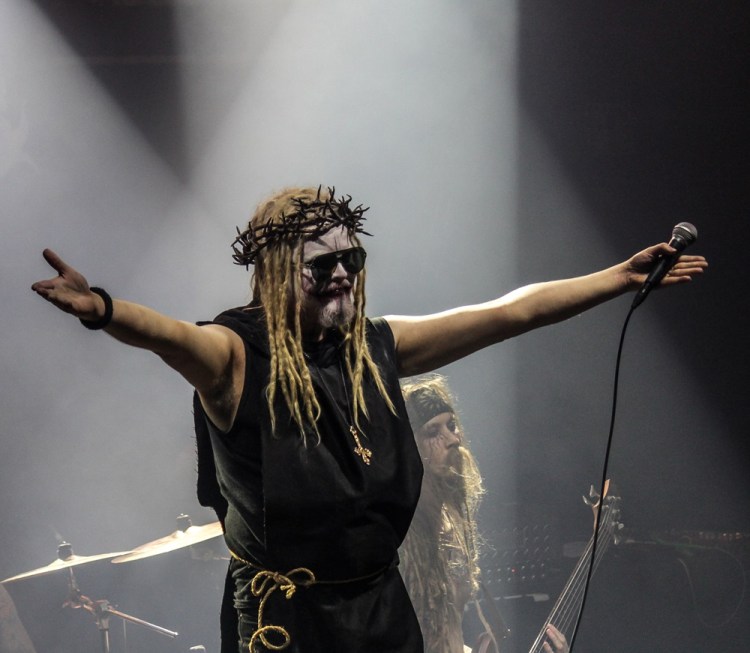
–The Devil’s Evangelion is, in many ways, the ultimate King Satan album. Everything we’ve done so far kind of summarizes there; the answer to your question is already visible in our live shows. We have religious and ritualistic elements combined with a rocking industrial metal show that features carnivalesque aspects, as this is how we form an alliance between the sacred and the profane. Some parts of our show are very well thought out in advance, but we also leave a lot of room for spontaneous impulses, which together create a balance of order and chaos. And so forth!
-King Satan has toured extensively with big names like Deathstars, Gothminister and Turmion Kätilöt. Have any experiences on the road influenced the direction of The Devil’s Evangelion?
-I guess it all has affected our songwriting process in the way that we want the music to sound the same on record as it does on stage.
This has led to the approach that if we can’t do something on stage, we shouldn’t do it on the record.
This is especially true for Occult Spiritual Anarchy and The Devil’s Evangelion, but who knows what we’ll do next.
-The album tracklist has intriguing titles like “The Carnivalesque of Dark and Light.” What inspired these songs, and do they represent different facets of the duality theme?
-The archetype of the Devil is quite a cornucopia of different points of view. The viewpoint of the so-called “God” in many religions is usually quite black and white. Especially in Abrahamic religions, which have influenced the entire moral compass of the Western world, even if a person has never regarded themselves as a believer in such religions, there is still a quite absolute view of good and evil lying underneath the moral fabric of this side of the world. The side of “God” represents the “Good,” while the side of the “Devil” represents the “Evil” from their perspective.
Contrary to popular belief, the viewpoint of the alleged “Devil” does not accept that division or the role of “evil” any more than the role of “good.”
In this so-called “Devil’s point of view,” this duality is only an illusion that can be transcended, and there are many more shades between the extremes from which reality is actually composed. And this is the real division: between absolutism and relativity. The synthesis of the duality of reality can be understood through paradoxes, not alien to mysticism and occultism nor poetry in general. Because through paradoxes, opposites become one again, reaching an existence beyond words, which is not accessible to ordinary speech but appears more authentic than what is available to the everyday tongue. And carnivalesque, as a literary mode, subverts and liberates the assumptions of the ruling style through humor and chaos, which is indeed an important facet of this album’s theme. In this understanding, the trickster has the power to ridicule the royal without getting punished, and jokes can reveal painful truths in the sense that clowning can be serious business. In this understanding, a sad clown may be funny, a lunatic a genius, a god may be slain, a human may become divine, and the Devil may be a God—paradoxically, all at the same time despite their seeming duality.
-Industrial and electro elements are integral to your sound. How did you approach these on this record to ensure it aligns with the evolving vision of King Satan?
-As a composer and producer, I can say that I don’t serve any musical style or genre as if I owe them any favors. The way I feel about music-making is that I just try to find the best way to channel what I feel and what I want to say. So far, I have found that industrial and electro elements serve me very well for this purpose, but with The Devil’s Evangelion, the symphonic and religious hymn influences have worked, if not even better than the previously mentioned styles, at least quite strongly this time. We share this feeling with the whole band when we make the music, and we ensure that our vision is served; the form it takes is kind of secondary to us. I wouldn’t be surprised if we someday make a full electro album or just a plain rock’n’roll album, because our musical style might be like the lyrical theme: it’s between the lines, behind the syntax.
-With this album being your fourth, how do you feel the band’s journey has evolved, both musically and personally, since your debut in 2015?
-We as a band have grown together quite well over the last few years, becoming a well-oiled machine, actually. Everything has developed so gradually, without any violent forcing, that we don’t usually even realize how much we have evolved as musicians. It feels like we have all found a way to express ourselves within the framework of what King Satan is, without compromising the main vision.
For the first time in my artistic history actually, I can say that when it comes to this album’s themes: I am this album. This personal and important it is to me actually.
I developed the theme over a decade, even before King Satan existed, but I never felt mature enough for it—not until 2022 when everything came together quite quickly. I just needed more experience as a musician, songwriter, and producer, as well as a lyricist, and also as a human being, actually.
-Saturnian Mist recently played their final show, marking the end of an era. How does it feel to close that chapter, and what prompted the decision to end the band?
-I guess it’s not a surprise answer to say that it was a really nostalgic thing to quit a 18 year old band, hah. It was my decision to stop actually, and I wanted to do it little bit sooner, yet the band members became my dear friends over the years, so I agreed to continue couple of years more mainly because of this. But I was primus motor of that band, founder, main composer, lyricist, art director, producer… Basically everything I am with King Satan too, and after ’Shamatanic’ (2021) album I felt that I had given everything I can give to Saturnian Mist and it’s time to move on, as nobody really wanted to continue without me either, not to re-invent the wheel so to say either, as we wanted to preserve this version of Saturnian Mist as it’s final version.
-Did Saturnian Mist’s philosophies or musical styles influence your work with King Satan, especially on The Devil’s Evangelion?
-It would be odd if it didn’t, since I wrote the lyrics and developed that “philosophy” and musical style, and I think even if I would not want to, the artistic process is cumulative and always builds on the top of the previous works one way or another. Thematically, and philosophically speaking, King Satan and Saturnian Mist are different sides of the same coin, and they are indeed a continuum. One King Satan fan expressed it much better than I could; she felt that Saturnian Mist was a more archaic, intuitive, and primitive form of the themes I started working with in King Satan afterwards. But it is true that without Saturnian Mist, there probably would not be King Satan, at least not in this format, because King Satan was born from compositions and aesthetics that didn’t fit into Saturnian Mist in my head.
The whole concept of The Devil’s Evangelion was originally intended to be a Saturnian Mist album actually, but I always postponed it because I did not feel ready.
The form always eluded me. The reason became apparent to me later on, which was that it was never supposed to be a Saturnian Mist album, but rather a King Satan album instead, and I realized this in 2022 when I tried to compose a new Saturnian Mist album after Shamatanic. The songs just sounded like King Satan, which was one of the reasons I wanted to disband Saturnian Mist.
-With Saturnian Mist’s music having such a deep focus on occult and spiritual themes, how have these themes evolved in your work with King Satan, if at all?
-I’m not sure if I’m the right person to answer to this actually. Things tend to evolve, but how? I guess let the art speak for itself.
-Finally, if you could summarize Saturnian Mist’s impact on the Finnish metal scene and your personal growth as an artist, how would you describe it?
-Heh, I think it’s too soon still for me to see the big picture, because I was too close with it for so many years. But it still surprises me that I get nowadays comments from varying places around the world actually how big impact Saturnian Mist was for them years and years ago. This because Saturnian Mist was always quite marginal band operating in the niche of black metal underground, which is quite closed community and culture below the radar of regular metal fans. And even there we were quite eccentric bunch even in the black metal underground context, but some weird reason (or just because of this) we had quite a drive and momentum going on there for a such small band early 2010’s for few years, even signed to a Candlelight Records and performed live quite actively in Europe, and caused quite controversy amongst the critics and fans with praising reviews or total bashing. I’m sure this does not sound any unfamiliar for the followers of King Satan either, because Saturnian Mist kind of revealed this side from myself to me where I realized how much I loved the power of friction and non-conforming approach, I cultivated even further with King Satan. I did actually give actually an extensive final interview about Saturnian Mist to Maizter Underground where people interested can read about these things more extensively.
Interview: Ditty
Photos: Péter Tepliczky
 MyTouché Blog